Introduction
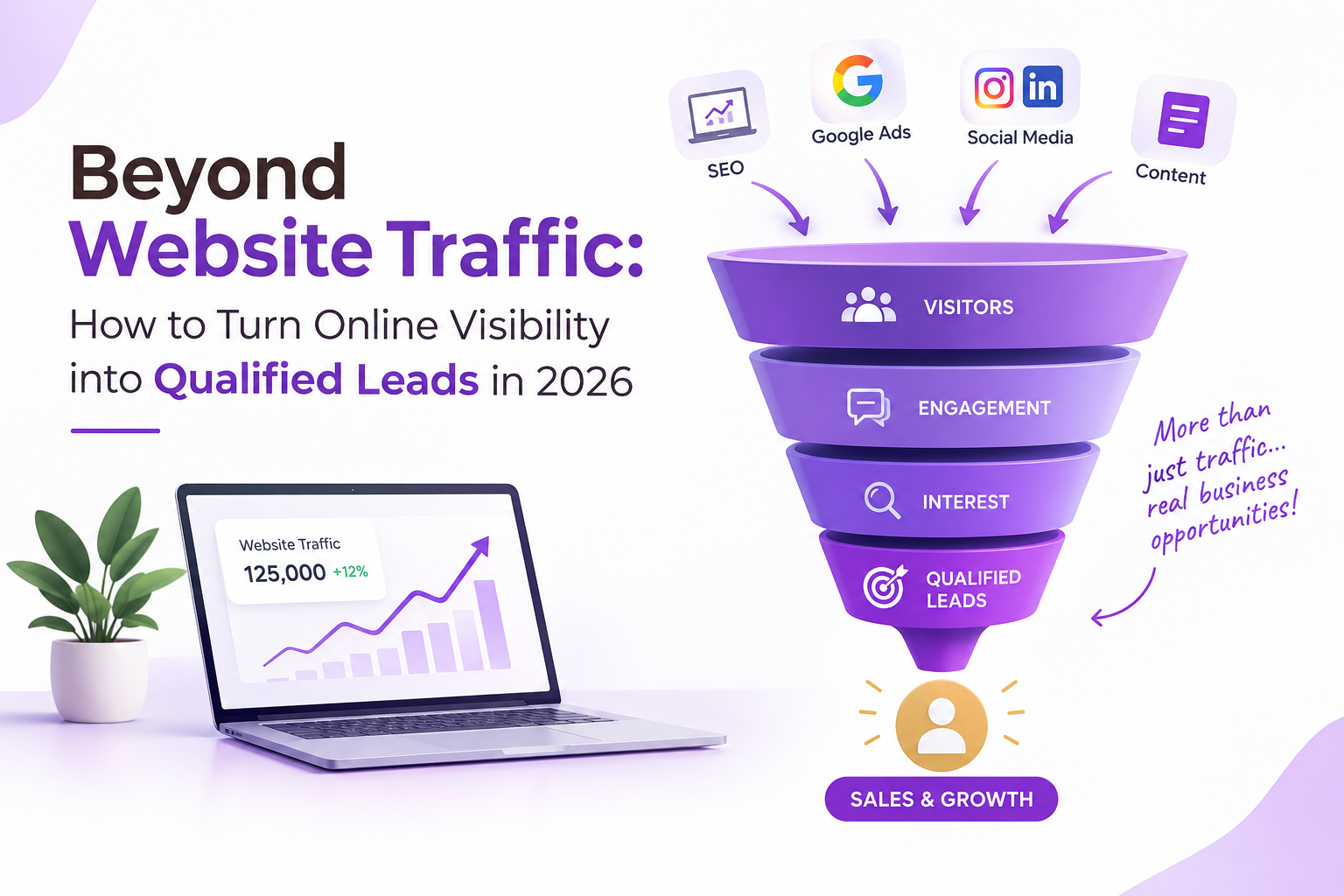
Getting more visitors to your website sounds like a successful marketing goal. But what happens when your website receives traffic without generating inquiries, consultations, or sales?
For many businesses, the real challenge is not simply attracting attention. It is attracting the right audience and giving those visitors a clear reason to take action.
In 2026, digital growth requires more than ranking on Google or publishing regular social media posts. Businesses need a connected strategy that combines search visibility, helpful content, user experience, audience targeting, and conversion optimization.
At Marcliq, the focus is on helping businesses build a stronger digital presence that supports measurable growth. Instead of treating every marketing channel separately, brands can create a connected customer journey that transforms online discovery into meaningful business opportunities.
1. Why Website Traffic Does Not Always Generate Leads
Website traffic measures how many people visit a website, but it does not automatically indicate purchase intent.
For example, a digital marketing agency may receive thousands of visitors searching for free marketing tips. However, only a small percentage may be interested in hiring an agency.
This difference highlights the importance of attracting relevant visitors rather than focusing exclusively on traffic volume.
Several factors can prevent website visitors from becoming leads:
- Incorrect audience targeting: Your content attracts people who are unlikely to purchase your services.
- Unclear messaging: Visitors cannot quickly understand what your business offers.
- Weak calls to action: Users do not know what to do next.
- Poor website experience: Slow loading, confusing navigation, or mobile usability problems discourage inquiries.
- Limited trust signals: Visitors cannot find enough information about your experience, services, or credibility.
The solution is to align your marketing activities with customer intent and make the next step simple.
2. Build an SEO Strategy Around Customer Intent
Search engine optimization remains an important part of digital growth, but an effective SEO strategy involves more than adding keywords to website pages.
Businesses need to understand what potential customers are trying to accomplish when they search online.
Search intent generally falls into four categories:
Informational intent: People want answers or explanations.
Example: How does SEO help a small business?
Navigational intent: People are looking for a particular brand or website.
Example: Marcliq digital marketing services.
Commercial investigation: People are comparing possible solutions.
Example: Best digital marketing agency for lead generation.
Transactional intent: People are ready to take action.
Example: Hire an SEO agency for my business.
A strong content strategy addresses these different stages. Educational blogs help users understand a problem, service pages explain available solutions, and clear inquiry options help interested visitors move forward.
Rather than publishing articles simply to increase website content, businesses should create pages that answer real customer questions and connect naturally to relevant services.
3. Optimize Your Website for AI Search and Answer Engines
Search behavior is evolving. People increasingly use conversational queries and AI-powered tools to research services, compare solutions, and understand unfamiliar topics.
This creates an opportunity for businesses to make their content easier for both people and search systems to understand.
Answer Engine Optimization (AEO) focuses on structuring useful information so that direct questions receive clear answers. Generative Engine Optimization (GEO) focuses on improving the chances that a brand’s content is understood, referenced, or surfaced in AI-generated responses.
Businesses can strengthen their content by following these practices:
- Answer important customer questions directly beneath descriptive headings.
- Include concise explanations before expanding into detailed information.
- Use specific examples, original insights, and verifiable facts.
- Keep business information, service descriptions, and contact details consistent.
- Use descriptive page titles, logical heading structures, and relevant internal links.
- Add appropriate structured data where it accurately represents the page.
- Build credibility through useful content, genuine customer experiences, and relevant references.
For example, instead of writing a vague heading such as “Our Digital Solutions,” a business could use “How Can Digital Marketing Help a Small Business Generate Leads?”
The second heading communicates a specific question and allows the content to provide a focused answer.
Important: AEO and GEO do not guarantee that a website will appear in AI-generated answers. They complement a strong foundation of technical SEO, helpful content, and credible online information.
4. Create Content That Supports Every Stage of the Customer Journey
One of the most common digital marketing mistakes is publishing content without a clear purpose.
A social media post may generate engagement, while a blog may attract organic visitors. However, these activities become more valuable when they work together.
Consider a business looking for website development services.
Its customer journey might look like this:
Stage 1: Discovery
The potential customer finds an educational blog about common website conversion problems through search.
Stage 2: Evaluation
The visitor reads a related article about choosing the right website platform and explores the agency’s portfolio.
Stage 3: Consideration
The visitor reviews the agency’s web development services, process, and relevant project examples.
Stage 4: Conversion
A clear call to action encourages the visitor to request a consultation or submit an inquiry.
This approach creates continuity between content discovery and business action.
At Marcliq, businesses can bring together SEO, content marketing, social media management, paid advertising, and website development to create a more connected digital presence.
5. Make Your Website a Conversion-Focused Business Asset
Your website is often one of the first places potential customers evaluate your business. Its design should therefore support both brand perception and user action.
A visually attractive website is valuable, but design alone cannot guarantee conversions.
A conversion-focused website should include:
A clear value proposition: Explain what you offer, whom you help, and what makes your business relevant.
Simple navigation: Help visitors find services, pricing information where applicable, portfolio examples, and contact details without unnecessary effort.
Mobile-friendly layouts: Ensure pages, forms, and buttons work smoothly across different screen sizes.
Visible calls to action: Use relevant prompts such as “Book a Consultation,” “Request a Quote,” or “Discuss Your Project.”
Trust-building elements: Display genuine testimonials, case studies, team expertise, and other verifiable evidence.
Easy inquiry forms: Request only the information needed to begin a conversation. Long or confusing forms may discourage interested visitors.
Performance monitoring: Review page speed, form completion, user behavior, and conversion data to identify areas for improvement.
A well-designed website should make it easier for the right customer to understand your offer and take the next step.
6. Connect Paid Advertising with Organic Marketing
SEO can help businesses build long-term organic visibility, while paid advertising can provide more immediate opportunities to reach selected audiences.
These channels can support each other when they share consistent messaging and clear business objectives.
For example, a business launching a new service could use SEO content to answer common customer questions while running targeted advertising campaigns to reach people who may be interested in that service.
The landing page should match the advertisement’s promise. If an advertisement promotes a specific service, visitors should arrive at a page that explains that service rather than a generic homepage.
To improve campaign performance, businesses should monitor:
- Cost per qualified lead.
- Landing page conversion rate.
- Lead quality and relevance.
- Follow-up response time.
- Appointment or consultation bookings.
- Sales generated from marketing campaigns.
The number of leads alone does not tell the complete story. A campaign generating fewer but more relevant inquiries may be more valuable than one producing a large number of unqualified contacts.
7. Measure Business Outcomes Instead of Vanity Metrics
Likes, impressions, website visits, and follower counts can provide useful context, but they should not be the only indicators of marketing performance.
Businesses need to understand which activities contribute to actual opportunities.
A practical measurement framework includes the following:
Metric | What It Helps You Understand |
Organic search traffic | Whether SEO is attracting visitors |
Qualified leads | Whether the audience matches your target customers |
Landing page conversion rate | Whether visitors are taking the intended action |
Cost per qualified lead | How efficiently paid campaigns attract relevant prospects |
Lead-to-customer rate | How effectively inquiries become customers |
Customer acquisition cost | How much it costs to acquire a customer |
Return on marketing investment | Whether marketing contributes to business value |
Tracking these indicators helps businesses identify which channels deserve further investment and which parts of the customer journey need improvement.
Results should be evaluated over an appropriate period, taking into account the business model, sales cycle, budget, and quality of available tracking data.
8. Common Digital Marketing Mistakes Businesses Should Avoid
Even a well-funded marketing campaign can struggle when the underlying strategy is unclear.
Avoid these common mistakes:
Chasing rankings without considering intent: High search positions are more valuable when they attract relevant visitors.
Publishing repetitive AI-generated content: Content should offer genuine value, accurate information, and original insight rather than simply increasing article volume.
Sending every advertisement to the homepage: Use relevant landing pages that match the audience’s needs and the campaign message.
Ignoring existing leads: Delayed or inconsistent follow-up can reduce the chances of converting an inquiry into a customer.
Running campaigns without tracking: Without reliable measurement, businesses cannot confidently identify which activities are working.
Expecting immediate results from every channel: Paid advertising, organic SEO, brand building, and conversion optimization can operate on different timelines.
Avoiding these mistakes helps businesses build a more sustainable and measurable approach to online growth.
9. How Marcliq Helps Businesses Build a Stronger Digital Presence
Even a well-funded marketing campaign can struggle when the underlying strategy is unclear.
Avoid these common mistakes:
Chasing rankings without considering intent: High search positions are more valuable when they attract relevant visitors.
Publishing repetitive AI-generated content: Content should offer genuine value, accurate information, and original insight rather than simply increasing article volume.
Sending every advertisement to the homepage: Use relevant landing pages that match the audience’s needs and the campaign message.
Ignoring existing leads: Delayed or inconsistent follow-up can reduce the chances of converting an inquiry into a customer.
Running campaigns without tracking: Without reliable measurement, businesses cannot confidently identify which activities are working.
Expecting immediate results from every channel: Paid advertising, organic SEO, brand building, and conversion optimization can operate on different timelines.
Avoiding these mistakes helps businesses build a more sustainable and measurable approach to online growth.
Frequently Asked Questions (FAQs)
1. How can a business generate qualified leads online?
A business can generate qualified leads through targeted SEO, useful content, paid advertising, conversion-focused landing pages, and clear inquiry forms. Consistent lead tracking and timely follow-up help improve the likelihood of converting relevant inquiries into customers.
2. Is SEO enough to generate business leads?
SEO can attract relevant organic visitors, but it is not always sufficient on its own. Businesses may also need strong landing pages, clear service information, compelling calls to action, paid campaigns, and an effective follow-up process.
3. What is the difference between SEO, AEO, and GEO?
SEO focuses on improving visibility in search engines. AEO focuses on making information easy to use in direct answers, while GEO focuses on improving how content and brands may be understood and referenced by generative AI systems. These approaches overlap and work best when built on useful, credible content.
4. How long does digital marketing take to produce results?
The timeline depends on the channel, competition, budget, website condition, and target audience. Paid campaigns can begin generating inquiries relatively quickly, although lead quality varies. SEO often requires sustained work over several months before meaningful improvements become apparent.
5. How do I know if my digital marketing strategy is working?
Evaluate relevant outcomes such as qualified leads, conversion rates, cost per qualified lead, customer acquisition cost, and sales attributed to marketing. Combine these indicators with website analytics and campaign data to make informed decisions.
6. Why should businesses work with a digital marketing agency?
A digital marketing agency can help businesses plan and coordinate online marketing activities, improve their website and content, manage advertising campaigns, and evaluate performance. The value depends on the agency’s expertise, communication, strategic fit, and ability to measure outcomes.
Conclusion: Turn Digital Visibility into Meaningful Growth
Online visibility is an important starting point, but sustainable digital growth requires a clear path from discovery to conversion.
Businesses need to understand their audiences, create content that answers genuine questions, improve their website experience, connect marketing channels, and measure the results that matter.
In 2026, the strongest digital strategies are not necessarily those that generate the most clicks. They are the ones that attract the right people, build trust, and make it easier for potential customers to take meaningful action.
Ready to strengthen your digital presence?
Explore how Marcliq can help your business with website development, SEO, paid advertising, content marketing, and lead generation.
Visit https://marcliq.com/ to learn more about our digital solutions and take the next step toward building a stronger online presence.
Marcliq — Grow Digitally. Scale Smartly.