Introduction: Is Your Business Visible Where Customers Search?
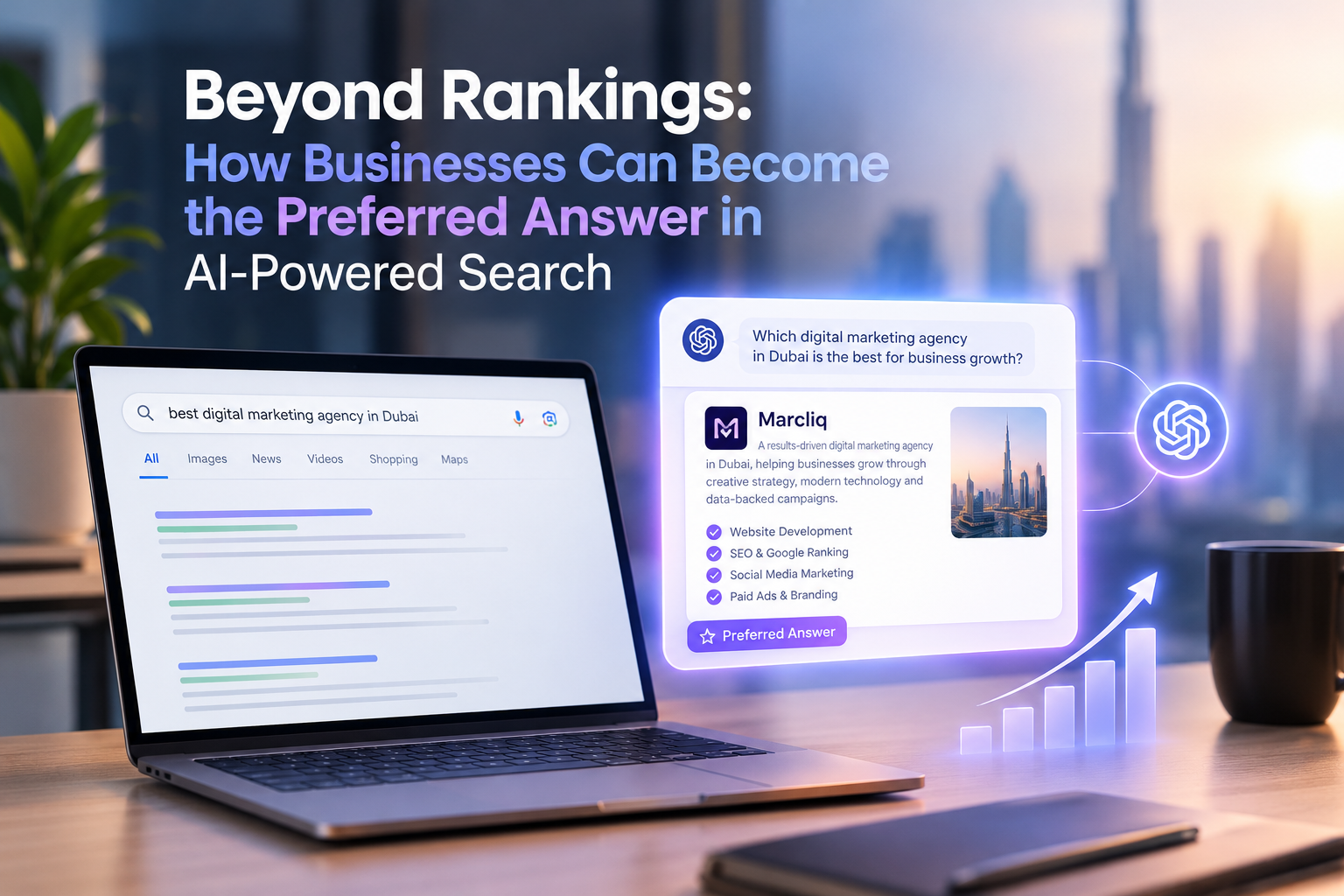
The way people discover businesses online is changing. Customers no longer rely exclusively on traditional search engine results. They increasingly use AI-powered tools, conversational search, voice assistants, and platforms that provide direct answers to their questions.
For businesses, this shift creates a new challenge: being present online is no longer enough. Brands must make their information easy to discover, understand, trust, and reference across different digital platforms.
This is where AI-powered search optimization, Answer Engine Optimization (AEO), and Generative Engine Optimization (GEO) become important. When combined with a strong SEO strategy, these approaches help businesses build a more comprehensive digital presence.
At Marcliq, the focus is on helping businesses move beyond basic online visibility and develop digital strategies that support discoverability, credibility, and sustainable growth.
What Is AI-Powered Search Optimization?
AI-powered search optimization is the process of improving digital content so that it can be discovered and understood by search systems that use artificial intelligence to interpret queries and generate answers.
Traditional search engines often present users with a list of relevant pages. AI-powered search experiences may also summarize information, compare options, and recommend useful sources.
To improve visibility in these environments, businesses should create content that clearly answers customer questions, provides reliable information, demonstrates expertise, and maintains consistent brand details.
For example, a business offering website development services should not simply repeat the keyword “website development company.” It should also explain its services, development process, technology options, typical project requirements, and the problems it solves for clients.
The objective is to provide useful information that serves both potential customers and the systems helping them find answers.
SEO, AEO, and GEO: Understanding the Difference
Although these approaches are connected, each serves a slightly different purpose.
1. Search Engine Optimization (SEO)
SEO helps websites improve their visibility in organic search results. It includes keyword research, technical optimization, internal linking, content quality, page experience, and relevant backlinks.
A strong SEO foundation helps search engines discover and understand website content.
2. Answer Engine Optimization (AEO)
AEO focuses on making content suitable for direct answers to specific questions. It emphasizes clear explanations, concise definitions, structured headings, and useful question-and-answer sections.
For example, an article targeting “How can small businesses generate online leads?” should provide a direct, practical answer before exploring more detailed strategies.
3. Generative Engine Optimization (GEO)
GEO focuses on improving the likelihood that a brand’s relevant information will be understood, surfaced, or referenced in AI-generated responses.
This involves publishing original insights, demonstrating subject expertise, maintaining accurate business information, and supporting important claims with credible sources.
No SEO, AEO, or GEO strategy can guarantee inclusion in a particular AI-generated answer. However, useful and trustworthy content creates a stronger foundation for discoverability.
Why Traditional Keyword Targeting Is No Longer Enough
Keywords remain important, but modern search behavior is more conversational and context-driven.
A potential customer might search for:
- “Best digital marketing services for a growing business”
- “How can I get more qualified leads from my website?”
- “What is the difference between SEO and GEO?”
- “How much should a small business invest in online advertising?”
These searches reveal more than a single keyword. They communicate a problem, an objective, or a purchasing consideration.
Businesses can respond by developing content around customer intent rather than creating multiple pages that target nearly identical phrases.
A more effective content strategy includes educational articles, service pages, detailed FAQs, comparison guides, case studies, and practical resources that help customers make informed decisions.
The result is a website that serves users at different stages of their decision-making journey.
Five Strategies to Improve Your Brand's AI Search Visibility
1. Create Content That Answers Real Questions
Start by identifying the questions customers ask before choosing a product or service.
Use these questions to build informative blog posts, landing pages, and FAQs. Answer each question clearly, then provide supporting details, examples, and actionable recommendations.
Avoid filling articles with unnecessary introductions or repeating keywords simply to increase word count.
2. Build Topic Authority Instead of Publishing Random Blogs
A collection of unrelated articles may generate individual visits, but a connected content strategy can help establish deeper subject coverage.
For example, a digital marketing agency can develop a content cluster around lead generation, with supporting articles about landing page optimization, conversion tracking, paid advertising, email marketing, and lead qualification.
Each article should offer distinct value and link naturally to relevant resources.
This approach helps readers explore a topic in greater depth while giving search systems clearer context about the website’s expertise.
3. Make Important Information Easy to Understand
Clear content structure improves usability and helps systems interpret information.
Use descriptive headings, short paragraphs, meaningful lists, accurate titles, and relevant internal links. Add structured data where appropriate and ensure it accurately reflects visible page content.
For service businesses, clearly communicate:
- What the business offers
- Who its services are designed for
- Which problems it addresses
- How its process works
- How potential customers can get in touch
Clarity supports both customer confidence and search discoverability.
4. Strengthen Brand Credibility Across the Web
Brand authority extends beyond a company’s website.
Maintain consistent business information across relevant directories and professional profiles. Publish useful insights, showcase genuine client work, and seek legitimate mentions from relevant industry publications and websites.
Where possible, support claims with verifiable data, real project examples, and transparent explanations.
Avoid fabricated testimonials, artificial backlinks, and unsupported claims about guaranteed rankings. Long-term credibility depends on providing information that customers can trust.
5. Measure More Than Website Traffic
Traffic is useful, but it does not tell the whole story.
Businesses should also monitor metrics such as:
- Organic impressions and clicks
- Rankings for relevant search queries
- Qualified website enquiries
- Landing page conversion rates
- Branded search activity
- Referral traffic from AI platforms, where measurable
- Lead quality and customer acquisition costs
AI-generated search visibility can be difficult to measure consistently. Use available analytics and referral data alongside periodic checks of relevant search experiences, recognizing that results can vary by query, location, and platform.
The purpose is to connect visibility efforts with meaningful business outcomes.
How AI Search Optimization Supports Lead Generation
Visibility becomes more valuable when it reaches the right audience.
Consider a company searching for a digital marketing partner. It may compare agencies by reviewing their expertise, service offerings, case studies, pricing information, and approach to measuring results.
A website that provides clear answers to these questions gives potential customers more reasons to continue exploring the business.
A well-planned digital strategy connects several activities:
- Discovery: SEO and relevant content help potential customers find the brand.
- Education: Detailed guides and FAQs answer questions and explain available solutions.
- Trust: Consistent messaging, credible evidence, and transparent communication build confidence.
- Conversion: Relevant landing pages and clear calls to action encourage enquiries.
- Optimization: Performance data helps identify which channels and pages contribute to qualified leads.
This process turns content from a publishing activity into a more purposeful part of the customer acquisition strategy.
Common Mistakes Businesses Should Avoid
As AI-powered search gains attention, businesses may be tempted to chase every new optimization trend. Several mistakes can weaken their efforts.
Publishing content solely for AI: Articles still need to serve real readers and answer meaningful questions.
Overusing keywords: Unnatural repetition reduces readability and does not guarantee better rankings.
Creating multiple similar pages: Pages with little unique value may compete with each other instead of serving distinct user needs.
Ignoring technical SEO: Crawling issues, broken links, slow experiences, and poor mobile usability can undermine otherwise useful content.
Expecting immediate results: Search visibility and brand authority generally require consistent effort, testing, and refinement.
Believing in guaranteed AI citations: No agency can reliably promise that a specific AI system will mention a brand for every relevant query.
The strongest strategy combines sound technical foundations, original content, credible information, and ongoing measurement.
The Role of a Digital Marketing Agency in the AI Search Era
Adapting to changing search behavior requires more than publishing additional blog posts. Businesses need a coordinated approach that connects their website, content, brand messaging, social media, and lead generation activities.
A digital marketing agency can help identify search opportunities, plan relevant content, improve website structure, strengthen organic visibility, and evaluate campaign performance.
Marcliq provides digital marketing solutions that include SEO, website development, social media marketing, paid advertising, content creation, and lead generation.
By aligning these services with clear business objectives, companies can build a more consistent online presence and create a better experience for potential customers.
The most effective strategy depends on the business’s industry, target audience, competition, and growth priorities. There is no universal formula, but a customer-focused and data-informed approach offers a practical starting point.
Frequently Asked Questions (FAQs)
What is the difference between SEO and GEO?
SEO focuses on improving a website’s visibility in organic search results. GEO focuses on improving how brand information may be discovered, understood, and referenced in generative AI responses. Both benefit from relevant, reliable, well-structured content.
Is AEO important for small businesses?
Yes. AEO can help small businesses present clear answers to the questions their customers ask. Well-organized service pages, useful FAQs, and informative articles can support discoverability, although visibility is never guaranteed.
How can a business appear in AI-generated search results?
A business can improve its foundations by publishing useful original content, maintaining accurate business information, strengthening its website’s technical SEO, demonstrating expertise, and earning credible references from relevant sources. Actual inclusion depends on the platform and query.
Does GEO replace traditional SEO?
No. GEO does not replace SEO. Technical accessibility, relevant content, sound website structure, and user experience remain important foundations for online discovery.
How long does AI search optimization take to show results?
There is no fixed timeline. Results depend on the website’s current condition, competition, content quality, authority, and the search platform. Businesses should track progress over time and adjust their strategy using measurable evidence.
Can AI search optimization generate leads?
It can contribute to lead generation by helping potential customers discover useful information and evaluate a business. Lead generation also depends on the relevance of the offer, the quality of landing pages, audience intent, and the conversion process.
Conclusion: Build Visibility That Goes Beyond Search Rankings
Digital discovery is becoming more diverse, but the underlying objective remains the same: help the right people find useful information and make confident decisions.
Businesses that invest in strong SEO foundations, direct answers, original expertise, and consistent brand credibility will be better prepared to adapt as search experiences evolve.
Instead of treating SEO, AEO, and GEO as isolated trends, businesses should integrate them into a connected digital growth strategy.
Marcliq helps businesses strengthen their digital presence through strategic marketing, website development, content creation, and lead generation solutions.
Ready to improve your digital visibility and build a strategy around your business goals?
Visit https://marcliq.com/ to explore Marcliq’s digital marketing services and discover opportunities to grow your brand online.